

Photo by Dietmar Becker on Unsplash
Content. Everything in the world is content. Your wedding. Your child’s first tooth. Moving to a new town or country. New shoes. New shoeees! In this era, the revolution is making sure everyone knows that you’re choosing to not share something.
How different is it from how we’ve always been? When we used drums or bells or village ceremonies or the telegraph — before phones and the internet, weren’t we still creating content? How is content not our nature?
“Maslow's hierarchy of needs is a motivational theory in psychology comprising a five-tier model of human needs, often depicted as hierarchical levels within a pyramid”—Source
The original 5 levels of the hierarchy were, from the bottom of the pyramid to the top:
Physiological ( air, water, food, etc)
Safety ( freedom from fear, law, order, safety from the elements),
Love and belonging (friendship, intimacy, trust, etc),
Esteem needs (mastery, dignity, achievement, status, prestige, etc) and
Self-actualization needs ( realizing one’s potential, self-fulfillment, etc.
In the 60s and 70s, the hierarchy was revised, with three needs added:
Cognitive, aesthetic, and transcendence needs. We won’t be exploring these today, and you can read all about the hierarchy and evolution here. What piqued my interest was Maslow’s comment and why he had to revise the original:
Regarding the structure of his hierarchy, Maslow (1987) proposed that the order in the hierarchy “is not nearly as rigid” (p. 68) as he may have implied in his earlier description.
Maslow noted that the order of needs might be flexible based on external circumstances or individual differences. For example, he notes that for some individuals, the need for self-esteem is more important than the need for love. For others, the need for creative fulfillment may supersede even the most basic needs.
Maslow (1987) also pointed out that most behaviour is multi-motivated and noted that “any behaviour tends to be determined by several or all of the basic needs simultaneously rather than by only one of them” (p. 71). — source
A couple of things jumped to my face when I got into this rabbit hole:
If you can read this, it means you own a device that can access the internet. By definition, you probably aren’t struggling to stay alive and wondering where your next meal will come. This means, there’s a higher chance that you have your basic needs met.
The need to belong, connect, be a part of a group, establish oneself as a necessary member of our direct community or across the world through the internet, manifests itself in many ways, one of which is our ability to make use of nearly everything in your lives as content. And eventually, compare our journey to others’
Once you’re able to move up on the pyramid, your motivation and goals change. What Maslow clarified could explain why you may see someone who seems to have everything you want, but can’t appreciate it. It’s not that they don’t want to—they just can’t. They aren’t motivated by it, and if they were before they got it, they aren’t anymore. So, where you are motivated to get what they want, they are either on a different level of the pyramid—or completely in a mix of needs.
They might have the followers, the job, the rent paid and food in the fridge, but because every time they go back to their parents’ and have to deal with that disappointment from their career path —or the happy life the ‘poorer’ sibling seems to have, it bleeds into their existence.
The powerful thing about the internet and how much we share is how easy it is to compare. This isn’t new.
Social comparisons may seem to serve several positive functions, including self-enhancement. Frequent social comparisons, however, have a dark side. Two studies examined the relationship between frequent social comparisons and destructive emotions and behaviors. In Study 1, people who said they made frequent social comparisons were more likely to experience envy, guilt, regret, and defensiveness, and to lie, blame others, and to have unmet cravings. In Study 2, police officers who said they made frequent social comparisons were more likely to show ingroup bias and to be less satisfied with their jobs. The dark side of frequent social comparisons was not associated with self-esteem. Results are discussed in terms of the role of individual differences in social comparison processes. — Source
If this already happens in the real world as we hang out with family and friends, can we be surprised that access to nearly everything makes it more so?
Even when we don’t have someone to compare to, it’s possible for us to simply create associations between who we were and who we are now, or something that happened to us and why we now think it was a good thing or a bad thing. The interesting thing about this is that we never consider the Nova Effect.
The Nova Effect is essentially this: things happen and we decide what they mean to us. When we look at a picture of a classmate and attribute the job they started at the ‘right time’ just before the company blew up, we’re making use of the Nova Effect. When a classmate gets married and his wife had ‘suddenly’ gotten her American Citizenship, he’s lucky—Nova Effect. That YouTuber who got the Cosmetics brand deal just because of that one video? Yes, you guessed it right.
But what do the Nova Effect and Maslow’s Hierarchy of Needs have anything to do with content or comparison?
The need to create stems from our internal motivation which may come from any of Maslow’s hierarchy levels. You may need to create because it’s your job and that job buys you food. You may need to create because that’s how you connect with your community online. You may create to exhibit your abilities as a thought leader and garner respect.
When we compare our needs to create—as well as the result of those creations—and forget to monitor the application of the Nova Effect to our lenses, we diminish the big picture of both the randomness of life’s events and the work that goes under the iceberg of the success we see online and offline.
This is good news.
Using Maslow’s updated hierarchy as a prism, you can start to understand your emotions when you notice that you’re comparing yourself with someone. You can leverage it to meditate on your actions and life. It’s possible then to decide what to do with the emotions:
Should you stop scrolling mindlessly or should you follow @Chrisdo and learn how to improve your personal Instagram feed?
Should you count likes to your articles on Facebook or turn your eyes towards self-publishing a book that will represent and pull more respect than a fleeting emotional oasis? The list of alternatives is myriad.
You have needs. We all do. Beating yourself for having them, or feeling bad that you want something someone has isn’t going to help you to understand why you want them. Attributing other people’s success minimizes how hard they have worked for it, their motivation, and also the role that randomness (luck) plays in their lives.
Not to even mention the hand of God in it all.
I find that the more I go inside to understand “where I’m at” the easier it is for me to not drown in self-pity or opinions that I can use to grow—even when they may not be comfortable to hear.
When you know why you’re doing what you do, and the part of the journey you can control, a lot of this confusion and comparison fades away leaving room for you to enjoy your process.
Now go, be.
Yo! Thanks for reading this. I promised a post on the new direction of my podcast. As I was researching why it was so hard to pick a Podcast niche—I ended up in this rabbit hole. As you can see. lol.
However, I recorded and published a new episode of the podcast that I would looove if you could listen and give me feedback. Here’s what someone said about the episode:
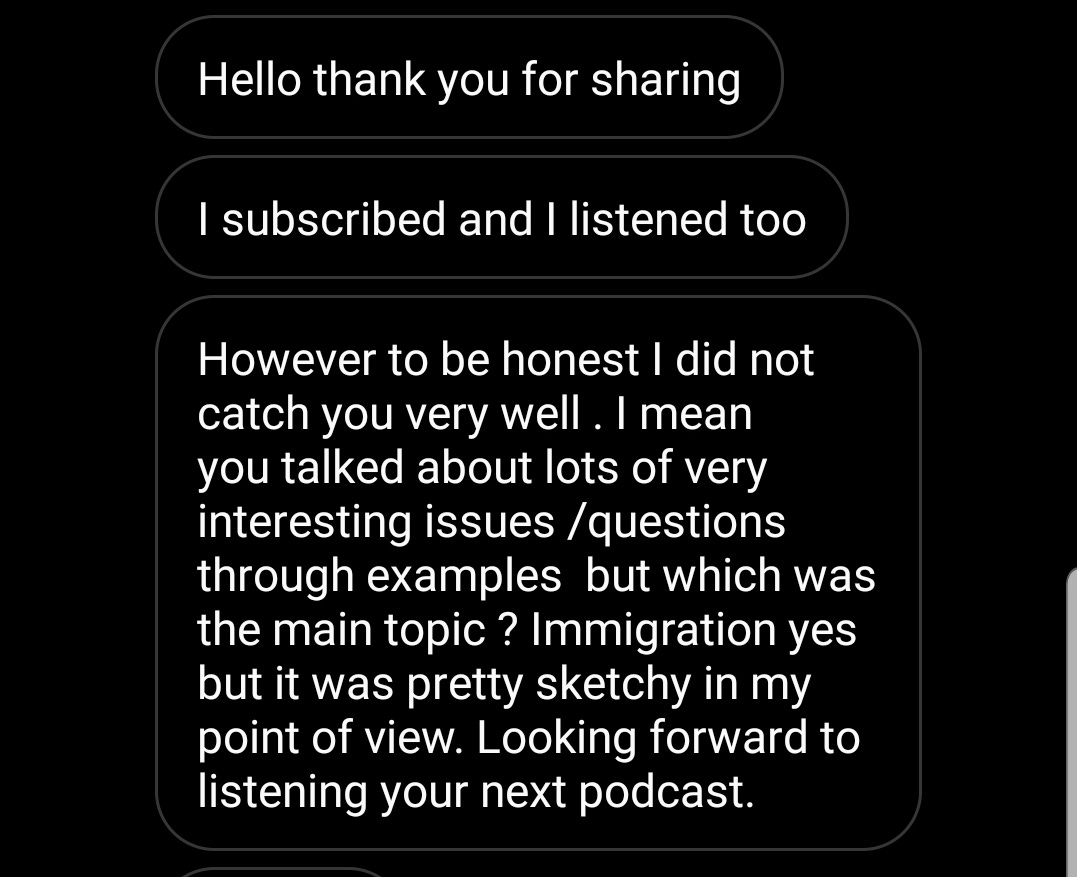
And this listener was right. I feel that being off the podcast game has been more detrimental than I thought. I start school on Monday—which I am very excited about because I’ll be studying a subject I can use in my writing forever. New episodes of the podcast drop on Tuesdays. Please, subscribe! Very excited about figuring this out again.
You can listen to the podcast on Apple Podcasts. Or right here on SoundCloud.
Also, if you’re a paid member, first hooraay! Second, what is a good time for me to call you to talk about the exclusive content I promised? I am making some edits and I need your feedback on the direction. Just hit reply and let’s get this going.